

How Your Horse's Muscles Really Work Together

A question I come back to again and again when I'm giving a lecture demo, or teaching on a course is this: why does a horse who feels strong and willing in one exercise suddenly feel stuck, resistant or unbalanced in another? Nine times out of ten, when we dig deeper, the answer is written in the muscles. It's not just simply which ones are doing the work, but how they're working together, and whether they're being asked for something they're actually conditioned to give.

I've written before about the basics of how muscles move a horse, if you haven't read that one, How Muscles Work is a good place to start, and I'll link it again at the end of this article too. This time I want to go a layer deeper and look into how muscles operate as chains running the length of the body, and into the different ways a muscle can actually contract.
Once you have this understanding, I promise you'll start reading your horse's movement completely differently, whether you're in the saddle, working from the ground, or watching him move round during turnout.
How Movement Actually Happens
Every single movement your horse makes starts the same way: a skeletal muscle pulls on a bone to operate a joint. Every bone in the body is moved by a muscle, and depending on where that muscle sits, it might cross just one joint or several. The longissimus dorsi is a good example — it runs the entire length of the thoracic and lumbar spine, crossing every joint along the way. The signal to do all this comes from the brain, travelling down neural pathways to tell each muscle precisely when to contract and when to relax.

As a rule, I think of it this way: the deep muscles, and the ones sitting close to the joints, are your postural muscles, they support and stabilise.
The muscles that create power and the big, expressive gymnastic movements tend to be the larger, more superficial ones, further away from the joint. The huge superficial muscles of the hindquarters are the classic example, they're what generates the propulsive power behind locomotion.
Muscle Pairs → Groups → Chains
At its simplest, muscles work in pairs. As one contracts, its partner lengthens, and that's what allows movement to happen. Think of your own arm: the biceps contracts and the triceps relaxes to flex your elbow, and it works the other way round to extend it.
No single joint is ever run by just one muscle. Movement depends on whole groups of muscles working together to create smooth, precise control, as one group contracts, the opposing group relaxes. We call these two groups the agonists (the ones doing the shortening, driving the movement) and the antagonists (the ones lengthening or stretching to let it happen).
It doesn't stop at groups, muscles also work in chains. This is what allows really precise control and continuous, flowing movement, and it's also why compensation happens: if there's a restriction anywhere in a muscle chain, you'll often see movement compromised somewhere else along that same chain. There are two main chains that affect the spine and hind leg, and both are central to propulsion.

1. The Extensor Chain (the “top line”)
These muscles sit above the spine and behind the hip, forming what most of us call the top line. I sometimes call this the extensor chain, because that's exactly what it does, it extends the hip and spine, hollows the back, and raises the head. This chain is largely responsible for forward propulsion, and the better conditioned it is, the more power your horse has available. A genuinely powerful extended trot, or a well-executed piaffe, simply isn't possible until these muscles are strong enough to produce it.

Key Muscles of the Dorsal Chain
The Splenius Muscle Runs from the spinous processes of the withers and the nuchal ligament to the poll and first four cervical vertebrae. Its job is to extend and elevate the neck.
The Longissimus Dorsi Part of the erector spinae group. A long, strong muscle running the length of the thoracic and lumbar spine to the pelvis, attaching at every vertebra along the way. It supports and extends (hollows) the spine and contributes to lateral flexion.
The Gluteal Muscle Group Made up of the superficial, medial and deep gluteal muscles. The medial gluteal (gluteus maximus) is the largest and most powerful gymnastic muscle of the hindquarters, and it's the main driver of hip extension during propulsion.
The Hamstring Muscle Group Biceps femoris, semitendinosus and semimembranosus. These powerful gymnastic muscles extend the hip and stifle during propulsion.
2. The Flexor Chain (the “bottom line”)
These muscles make up the bottom line, sitting underneath the spine and in front of the hip, the abdominal muscles are part of this group. I call this the flexor chain because it flexes the hip and vertebral joints, flexing the back, and lowering the head. As part of the horse's ‘core’, these muscles play a crucial role in supporting correct postural alignment through the back, and they're essential for any movement that requires collection.

Fact File — Key Muscles of the Ventral Chain
The Sternomandibular Muscle Runs from the sternum to the mandible, flexing the neck and pulling the head down, while also helping to open the mouth and support the jaw.
Abdominal Muscles The rectus abdominis, transverse abdominis, and internal and external abdominal obliques. Beyond supporting the abdominal viscera and aiding breathing and defecation, together these muscles create flexion (lift) and lateral flexion through the thoracolumbar spine.
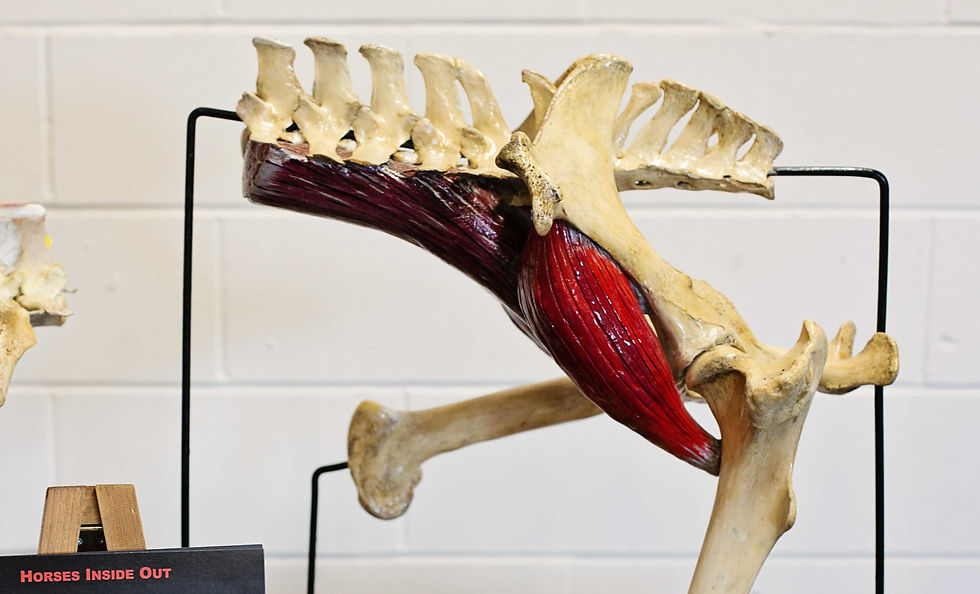
The Iliopsoas Muscle Group Psoas major, psoas minor and iliacus, attaching along the ventral side of the lumbar spine and pelvis, as well as the lesser trochanter of the femur. One of the main contributors to hip flexion and to movement of the pelvis through flexion at the lumbosacral junction.
The Quadriceps muscles Runs from the underside of the pelvis and front of the femur, via the patella to the front of the top of the tibia. This is an important group involved in extending the stifle and flexing the hip to advance the hindlimb forwards.
How the Chains Work Together
When the flexor and extensor chains are properly balanced, you get a genuine state of equilibrium. But because so much attention tends to go on the top line, I find the tone of the abdominal muscles often gets overlooked, even neglected.

Tension anywhere in a chain can have a knock-on effect anywhere else along it. If the longissimus dorsi goes into spasm, for example, that will affect the mechanics of the whole extensor chain and in turn inhibit the flexor chain too. I really can't overstate how important the abdominal muscles are within that flexor chain.

Once you understand that muscles work synchronously in chains, it becomes clear that no part of the horse's body can ever really be affected in isolation. Work on one part of a chain and you'll see an effect ripple through both that chain and its opposing partner. Increase flexion at the hip joint, for instance, and you'll inevitably affect the position of the pelvis, the back, and through the muscle chains the neck too.
Types of Muscle Contraction
This is the part I think really transforms how people train horses. Muscles are triggered to contract by nerve impulses, and they relax again once those impulses stop. Broadly, a working muscle does one of two things:
1. Isotonic Contraction — where the muscle produces movement
This splits into two categories, although in practice almost every movement uses a blend of both:
• Concentric — the muscle shortens to create movement.
• Eccentric — the muscle gradually lengthens to control movement, and to support and stabilise the joints. This type of contraction also acts as a shock absorber during sudden movements, like coming to an abrupt halt.

2. Isometric Contraction — where the muscle holds a position
Here the muscle is working hard, but its length doesn't change, it's contracting to hold, not to move.
In my experience, isometric and eccentric contractions tend to create more fatigue, tension and discomfort than concentric contraction does, especially if the muscle isn't well conditioned for the job. When it comes to training, understanding isometric contraction in particular really matters.
Isometric Contraction in Practice
Horses use isometric contraction a great deal in dressage, particularly when working in more advanced outlines. When the top line muscles of the neck, the splenius included, contract concentrically (shortening in length), they extend the neck and raise the head. When those same muscles work isometrically instead, they help maintain a flexed outline, holding the considerable weight of the head steady. In a more novice outline, or when the neck is stretched long and low, the nuchal ligament takes on more of that load-bearing role instead.
The abdominal muscles, deep back muscles and iliopsoas muscles also rely heavily on isometric contraction to support the back under the weight of a rider.

When a horse performs movements that demand real collection and engagement, the hamstring group (part of the extensor chain) works isometrically too, both to support the joints in a more flexed position and to carry a greater share of the weight.
Even travelling calls on isometric contraction, as the horse braces and supports itself against the movement of the box. It's one of the reasons an hour in the lorry or trailer can take about as much out of a horse as twenty minutes of trot work.
Sustaining isometric contraction well, and over a longer period, takes real strength and appropriate conditioning. Try holding a weight out at arm's length for a few minutes, or standing with all your leg joints flexed, you'll soon feel that familiar burn or ache. That's isometric fatigue, and the only real relief is to move the body part and let the muscle change length again.
Isometric work demands that level of strength and conditioning and because of this, problems can start to creep in when young or relatively unconditioned horses are asked to hold too advanced an outline for too long. Rather than holding the position isometrically, the horse may start compensating through concentric contraction instead, and the rest of the dorsal chain may begin shortening concentrically too, as part of that evasion pattern. This is exactly why it matters so much to give horses regular breaks to stretch and move their necks during training sessions.
A Small Part of the Puzzle
There's a huge amount to say about how muscles contribute to movement. What I've covered here in this article, the concept of muscle chains and the difference between isotonic and isometric contraction, is really just two small pieces of a much bigger and more fascinating subject. Even these two ideas, once you start noticing them in the way your horse moves and responds, can completely change how sympathetically and effectively you train.
If you'd like to study this further, my books Horse Anatomy for Performance and Posture and Performance both explore the action of muscles, and muscle chains, in a lot more detail. Also, if you'd like to revisit the fundamentals of how muscles move a horse in the first place, my earlier post, How Muscles Work, is a good companion to this one. If video learning is more your style check out the on-demand webinar Understanding Muscles and Fascia


This information is vital to anyone who owns a horse or works with horses. I am so grateful for all of the Horses Inside Out articles.