

Understanding Your Horse’s Posture and Why It Matters


Most of us know when something doesn't look quite right with our horse, but being able to pinpoint what and why is a different skill altogether. Over the last 20 years, studying anatomy and biomechanics and working with thousands of horses through Horses Inside Out, I've developed a practical system for assessing posture. It's something I cover in depth in my book Posture and Performance, but this article is designed to give you a clear, usable guide you can start applying straight away.
What is Good Posture?
Good posture is when the bones and joints are aligned in the middle of their available range of movement — think of the "neutral spine" concept you may have come across in Pilates or the Alexander Technique. In this position, muscles work efficiently, joints move freely, nerves aren't compromised, and forces are distributed evenly through the body's tissues.

For your horse, that means freer, more balanced movement, greater comfort, better performance and a lower risk of injury and a longer working life.
Poor posture, even involving only small changes in joint position, creates knock-on effects throughout the whole body. A slightly extended lumbosacral joint, for example, will influence the thoracolumbar spine, the base of the neck, the sacroiliac region and the limbs.
Because everything is mechanically connected, many of the changes in shape or muscle development we notice are symptoms rather than root causes.
It's also worth knowing that posture and "way of going" are related but not the same thing. Posture can be assessed when a horse is moving, being ridden, or standing square — but I actually find that a horse's resting posture is one of the most revealing things of all. How a horse naturally chooses to stand tells us a great deal about what feels easy and comfortable to his body.
Posture versus Conformation

Conformation is the shape a horse is born with bone lengths, proportions, overall frame. That can't be changed.
Posture, however, can either exaggerate conformational weaknesses or help compensate for them.
A long-backed horse with weak muscles and trailing hind legs will look even longer and weaker. The same horse, well-muscled, carrying himself with good hind limb positioning and thoracic support, can look like a completely different animal.
The Hollowed (Extended )Back
The postural pattern I see most often is an extended (hollowed) thoracic and lumbar spine. Gravity, lack of strength, incorrect training, excess weight and the addition of a rider all contribute. This posture increases strain on the ligaments, facet joints, vertebral bodies and surrounding soft tissues, and is associated with many back problems, performance limitations and even behavioural changes.

Adding a rider will always increase spinal extension to some degree, and this is why developing postural strength before and alongside ridden work is really important.
The Four Pillars of Good Posture
To improve posture, we first need to know what we're looking at. I assess it through four key areas:
1. The Hind Limbs
The hind limbs have a powerful influence on spinal posture. A useful way to feel this yourself is to stand on one leg and swing the other forward and back. As you do this you'll feel your own back subtly flex and extend. The horse's hindleg has a similar relationship with the back. Having the ability to bring the hindleg underneath the body is so important (look at the over-track) but it’s not the sole indicator of good hindlimb action.
We want horses to carry a good proportion of their weight behind... think "soft squat," not locked-back knees. Look at your horse standing naturally: are his hind legs positioned underneath the pelvis, out behind, or too far forward? Plumb lines from the point of buttock and the false hip (tuber coxae) are useful visual guides.
Helpful exercises include collection work, well-ridden transitions, backing up, backward weight shifts and in-hand Pilates-style exercises.
2. The Forelimbs and Thoracic Sling

The forehand is often overlooked, but the thoracic sling muscles, which suspend the ribcage between the front legs, have a significant effect on back posture.
In good posture, the forelimbs are vertical, the withers and base of the neck are supported in an "up and back" position, and the chest doesn't drop or bulge forward. In poor posture, the sternum protrudes, the forelimbs sit behind the vertical, and hollows appear behind the shoulder blades.
This hollow is often assumed to be muscle wastage (atrophy of the trapezius), but usually the main cause is a positional change in the thorax, it moves forward and down between the front legs, altering the appearance of the shoulder area.
Helpful exercises include wither rocks, cervicothoracic sways, raised poles, backing up and thoughtful groundwork.
3. The Neck
When I'm assessing posture, I pay particular attention to the underside of the neck. The line from sternum to chin should be open and gently curved. At the base of the neck, we ideally want a straight or slightly concave outline, a convex bulge here often reflects disengaged hind limbs, an extended back and a dropped thorax. Everything connects.
Backing up, raised poles, teaching your horse to correctly lower his head and appropriate feeding positions can all help.
4. The Abdomen

Think of the abdominal muscles as "the front of the back." Weak abdominals mean poor spinal support... just as they do in humans.
Look at the lowest point of the belly, the shape from sternum to sheath, and the width of the ribcage. A flat, triangular underline often suggests low abdominal tone.
Helpful exercises include sternum scratches, lateral shifts, backing up, pole work, canter work and gymnastic exercises.
Putting It All Together: A Real-Life Example
George, 7-year-old 17.2hh Irish Sport Horse.
George is a stunning young horse, but his back is in a slightly extended posture for his age and type. You can see a slight downhill angle to the lumbar region. Ideally this should be closer to horizontal.

Working through the four pillars: his hind limbs are reasonably well positioned under the pelvis (Pillar 1), which is good but he is a little too straight through his hock and stifle. He would benefit from better thoracic sling and abdominal tone (Pillars 2 and 4). The level of his withers is only just level with his point of croup, indicating a slightly downhill balance. The ventral line and jugular groove at the base of his neck are very slightly convex. This is a tell-tale sign of a slight forward-and-down position of the base of the neck and thorax (Pillars 2 and 3), which in turn puts his back into slight extension. He also lacks topline muscle development, though an improvement in posture would make this far less obvious.
The question about all of this of course is WHY? Is he uncomfortable somewhere? Is his work of good quality and an appropriate amount? Does all his tack fit well? What about his teeth, hoof balance, internal health? This is where a good multidisciplinary team support is vitally important.
George's exercise plan: Backing up, raised walk and trot poles (lunging and ridden), hill work, and Pilates-style exercises including sternum scratch, wither rock, hindlimb lateral sway, and carrot stretches (low to the side and low between the front legs). Ridden work to include hill work, pole work, transitions and lateral work.
A Final Thought
Posture isn't cosmetic. It is fundamental to your horse's soundness, comfort and performance. By understanding how the hind limbs, forehand, neck and abdomen work together, you can start to assess your horse far more accurately and support him far more effectively.
Small, regular interventions that are done little and often can make a profound difference over time.
In my experience, once you learn to see posture clearly, you can never look at a horse in quite the same way again.
If you want to delve a little deeper into equine posture, I highly recommend reading my book, Posture and Performance. This beautifully illustrated book gives you all the ingredients you need to put together an effective, varied and safe training programme.
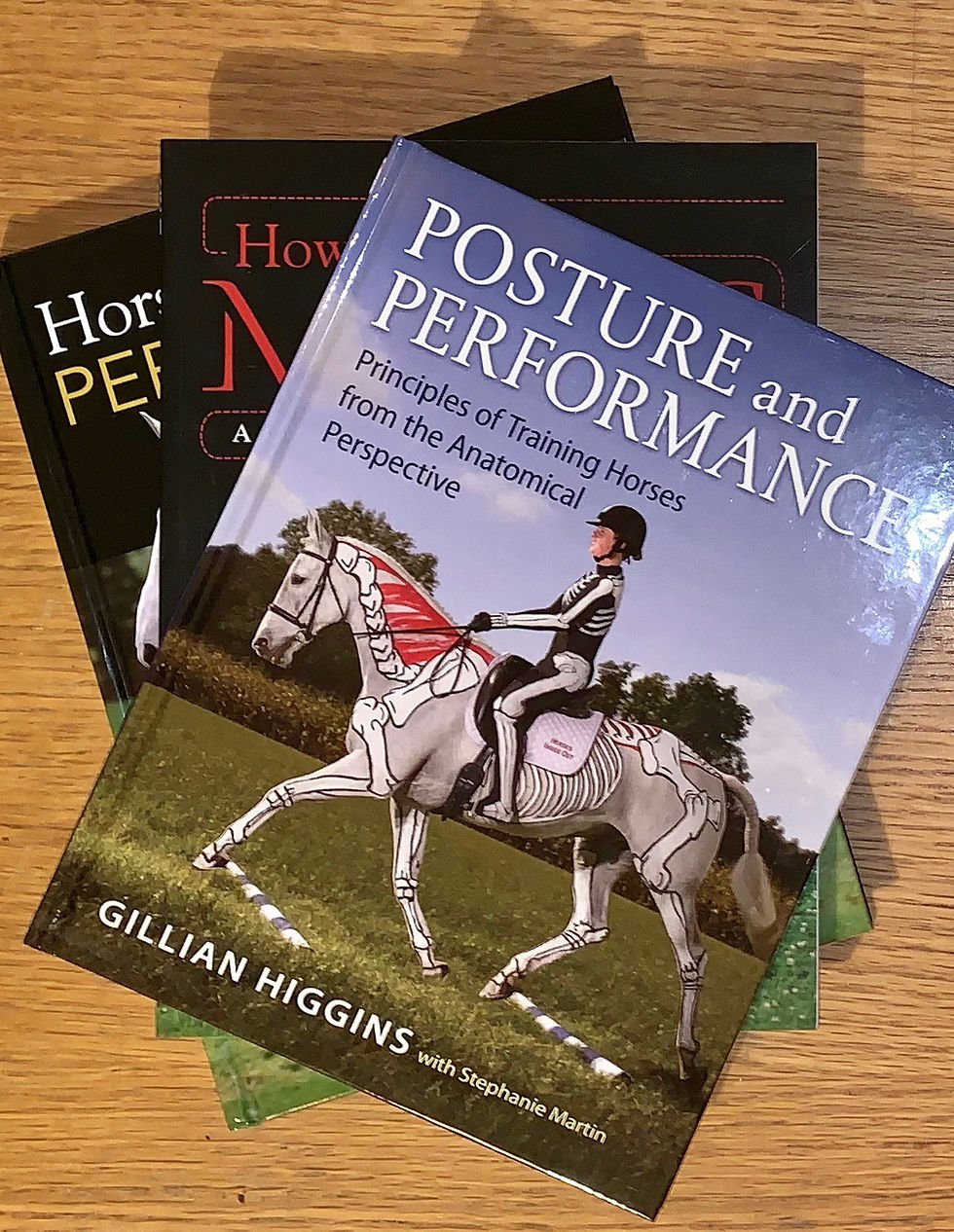
Posture and Performance is refreshingly different and encourages you to look at training and management from a completely different perspective. After reading this practical and comprehensive riding and training guide you will have a better understanding of how your horse functions, so you can maximise his potential, improve your skills, reach your goals and enjoy your horse to the full.
Posture and Performance is based on the principles of anatomy and biomechanics with the welfare of the horse in mind. Split into two parts, the first section covers the principles of training where you’ll learn about what you’re trying to achieve in your training from the anatomical perspective. Plus, discover the importance of posture as well as learning about asymmetries and compensation patterns.
The second part is exercises for performance. Here you’ll learn lots of tips and exercises that will help to improve your horse’s posture, paces, core stability, flexibility and more.


Comments