

Why the Base of the Neck Key to Your Horse Going in a Correct Outline

When people ask me about "outline," they often talk about the head and neck. I always want to stop them for a moment, because the neck can't really be talked about on its own. You will hear me say this a lot - everything is connected to everything else. So, while this article focuses on the head and neck, I want you to keep in mind that what we do when we are riding with the reins at the front end has consequences all the way through the horse's body.

Let's start at the top, quite literally, with a ligament that I think is one of the most useful things a horse owner can understand.
The Nuchal Ligament
The nuchal ligament runs along the crest of the neck. It's a strong, elastic ligament that attaches at the back of the skull (the cranium) and runs down to the top of the withers, roughly under where your hands sit when you're riding. This part is called the funicular part.
From the withers, a second portion of the ligament, the lamellar part fans out and attaches onto the second, third, fourth and fifth cervical vertebrae. This is the part that allows the horse to raise and lower its head.
Here's the bit most people don't realise: the nuchal ligament doesn't stop at the withers. It continues all the way along the back, changing its name to the supraspinous ligament as it goes, and attaching onto the tops of the spinous processes the whole way through. It becomes much less elastic the further back it goes, but it’s one continuous structure from the poll to the pelvis.
As a rider or trainer why does this matter? This continuous structure means the position of the head and neck directly influences the position of the back.
Seeing it in action
When the horse's head is held up high (see picture below), the nuchal ligament goes slack and the back drops down.

As the head comes down (see below), the ligament is pulled taut, and that tension transferred into the supraspinous ligament along the back
you can also see the back lift in response.
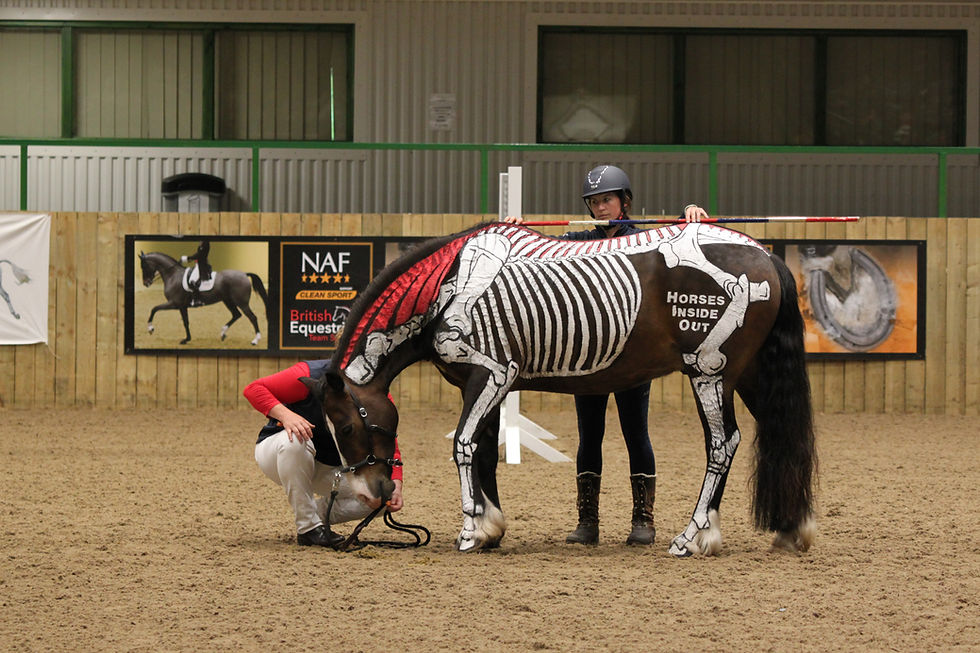
The really important point here is that the nuchal ligament is not a muscle. Lifting the back this way isn't the result of muscular contraction, it's a passive, ligament-based mechanism the horse has evolved to help carry the significant weight of its head and neck.
Why the Weight of the Head Matters
The head alone accounts for roughly 4% of a horse's total body weight, and the neck a further 6%. That's 10% of the horse's entire bodyweight being carried out in front of the forelegs.
Think about a sleeping horse: the poll is roughly level with the withers, and at that point, the nuchal ligament is doing the work of supporting the head with minimal muscular effort. Take it a step further and think about a sedated horse, even less muscular effort is involved, and the head is essentially hanging on the ligament system.
Stretching, or Something Else?
This brings me to the topic of stretching and a phrase I hear trainers using a lot: "look, he's stretching." When a horse's head goes forward and down, is it really stretching, or is something else going on?
Think about it this way. After a hard workout with your horse, if you give a long rein at the end of the session, where does the head go? Forward and down. Now think about yourself after a run, do you feel a genuine physiological urge to stretch, or do you just want to lean on something? I know which one I feel.
I'd suggest that when a horse drops its head forward and down on a long rein, it's largely doing the same thing, hanging the weight of its head, neck, back, abdomen and rider on this ligament system, rather than actively stretching. It's a valuable distinction to make, because it changes how you think about "long and low" work: it's a way of supporting the back through the ligament system, though it will put a little more weight onto the forehand, which is worth bearing in mind.
Where Movement in the Neck Really Happens
Once we understand the ligament running along the top of the neck, it's worth looking at the bony landmarks underneath, the transverse processes, which you can actually feel as a line of bumps running down the side of the neck.

The first joint: skull to Atlas (Atlanto-occipital joint)
The first cervical vertebra is called the Atlas, and it has a very distinctive "wing" shape. The joint between the skull and the Atlas allows mostly flexion and extension, along with a small amount of lateral flexion, around 22 degrees to each side (44 degrees total), and roughly 90 degrees of flexion and extension.
The back of the mandible (jaw) sits right next to this joint, and there's an important relationship between the two that riders and trainers should be aware of. In extension, the space between the mandible and the first vertebrae opens up nicely, this is good for the soft tissues in that area, like the pharynx and larynx. In flexion, that space closes.
Key training point: for lateral flexion to happen at this joint, it needs to be in the mid-range of flexion and extension, not fully flexed, not fully extended. If it's in extension, you won't get lateral flexion. If it's over-flexed, you won't get it either. This is actually true of every joint in the body. Try it yourself: hold your wrist straight and try to bring your thumb toward your elbow; you can rotate. Now flex your wrist and try the same thing; you can't do it in the same way. Same principle, different joint.
When you do get correct lateral flexion at this first joint, you'll notice the mandible bulges very slightly to the opposite side, almost like a small rotation around the long axis of the neck.
The second joint: Atlas to Axis (rotation)
The joint between the first and second cervical vertebrae is where the vast majority of neck rotation happens, around 180 degrees. There's virtually no rotation at any of the other joints further down the neck.
This matters because a head tilt is most likely coming from this joint, or secondarily from the joint between the skull and the Atlas. If this joint becomes over-flexed and a rider then asks for lateral flexion, the horse simply can't produce it from that joint, it's locked. Instead, the horse compensates by twisting from the joint below, which is exactly the kind of evasion we want to avoid. Keeping the space between the mandible and the first two cervical vertebrae open helps the horse stay straight through the head, rather than tilting or twisting to compensate.
The stiffest joint: C2–C3
As we travel down the neck, movement generally increases but the joint between the second and third cervical vertebrae is actually the stiffest joint in the whole neck. There's essentially no rotation here, only around 20 degrees of lateral flexion, and some flexion/extension.
This is also where you'll find the nuchal crest, the strongest attachment point of the nuchal ligament onto the cervical vertebrae. When a horse is heavily flexed with the nose behind the vertical, this becomes the highest point of the neck, which is not correct.
The Base of The Neck
Movement continues to increase as we travel down toward the base of the neck, where we see around 45 degrees of lateral flexion and 30–33 degrees of flexion/extension. That's considerably more range of motion but where you have more movement, you often also have more potential for weakness.
Because there's so much lateral flexion available at the base of the neck, this is very often where a horse will fall out through the shoulder if the base of the neck isn't correctly controlled. For me, this is the single most important area to understand when we talk about outline. It isn't really about where the nose is, it's about what's happening at the base of the neck. Is it lifted, or is it dropping down? A dropped, pushed-down base of the neck tends to show up as a convex shape rather than a nice concave one, and can create that "broken neck", where the neck comes up almost vertically and then ties in tightly at the top.
The Muscle Behind Lifting the Base of the Neck

The main muscle responsible for lifting and retracting the base of the neck is the longus colli. It sits on the underside of the cervical vertebrae and continues into the thoracic cavity, attaching onto the underside of the first five thoracic vertebrae. Interestingly, there are no other muscles attaching to the underside of the thoracic vertebrae again until much further back, where we find the psoas, which tells you just how specialised and important this muscle is for lifting and retracting the base of the neck.
Backing Up
This is where backing up comes in, and it's something I believe every horse should learn in-hand, ideally before they're even started under saddle. I think of it almost as a Pilates exercise for horses.

When done well, backing up with the head and neck in a lowered position:
Strengthens the thoracic sling
Switches on the longus colli and abdominal muscles
Moves the back through a different, valuable range of motion, often more than you see in the walk
The mechanics are worth understanding too. When you ask a horse to take a front leg backward, you directly flex the horse's back. Part of this is due to the physical connection through the stay apparatus of the front legs, and part is due to a shift from the extensor muscle chain into the flexor chain. You can feel a version of this yourself: lift your arms above your head and notice your back move into extension; bring your arms back down and feel your back flex. Taking the front leg back works in a similar way.
The critical detail with this exercise is that the horse must not throw its head up during rein-back. If the head goes up, you lose the lifting effect through the back and base of the neck entirely. This is why it's essential to take time to teach this quietly and correctly, ideally in-hand first, before asking for it under saddle.
My Top Three Takeaways
If you take nothing else away from this article, here are the three things I'd like every horse owner and rider to practise:
Practise backing up. Done correctly and patiently, it's one of the most valuable exercises you can teach your horse in-hand.
Focus on the base of the neck. Aim for it to come up and back, rather than focusing purely on where the nose is.
Use your body, not the reins, to influence your horse. Slowing down, adjusting your seat and body position, and being patient with the process will do far more for your horse's way of going than pulling on the reins ever will.
Understanding the anatomy behind the nuchal ligament, the joints of the neck, and the muscles that support them isn't just interesting theory. It allows you to feel and recognise correct movement and outline when you're working with your own horse.
Deepen Your Knowledge Further
There's a host of amazing resources available in the Horses Inside Out Academy that will give you a much deeper insight into your horse's neck and riding in an outline. Here's what we suggest you take a look at:
Understanding Your Horse's Neck
This on-demand webinar looks at how positioning of the horse’s head and neck influences back position, outline, movement, performance, comfort, welfare and way of going.
It studies the anatomy and location of the cervical vertebrae, spinal cord, cervical nerves, muscles, fascia and ligaments within the neck and explains how these structures have an enormous anatomical and biomechanical influence on ‘How the Horse Moves’.
The Biomechanics of Bending
Take an in-depth look at the biomechanics of exactly how the horse creates lateral flexion. Understand the anatomical range of lateral flexion available in each joint through the spine and in other relevant parts of the body. This on-demand webinar also looks at factors which cause a horse to struggle with lateral flexion and bend and how this can affect posture, symmetry, balance, and correct way of going.
The Thoracic Sling - Improving Posture and Movement
Study in detail at the anatomy of the thoracic sling muscles and how to assess their strength. and appropriate exercises to stretch and strengthen them.
Dressage Dissected
This online recorded lecture demonstration covers many popular topics such as; how the horse maintains an outline, the different head and neck positions and how those different positions affect movement and way of going.


Comments