

Is Your Mare Really "Moody"? What the Science Actually Says

Ask almost anyone in the horse world and they'll tell you: mares can be tricky. Chestnut mares especially. It's almost accepted wisdom that when a mare plays up — pinning her ears, swishing her tail, becoming sensitive around the girth, or simply seeming "difficult" — she's just being hormonal. In season. Mareish.
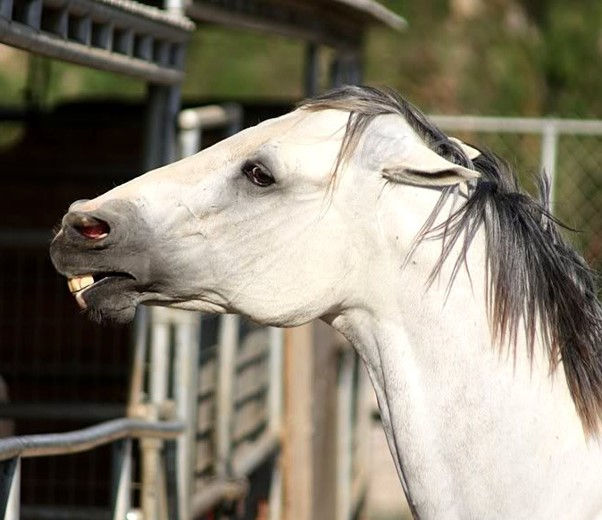
What if that assumption is not only wrong, but actively harmful?
A landmark new study by Dr Kareskoski, a European specialist in equine reproduction, suggests that the idea of the "moody mare" is far more myth than reality [1] — and that buying into it could mean missing a genuine health problem.

In the next article in the Sue's Snippets of Science series, Dr Sue Dyson unpicks this research to make it easy to understand and highlights the take home messages.
What the Research Found
Dr Kareskoski conducted a retrospective analysis of horses referred to the University of Helsinki between 2008 and 2025, specifically looking at cases where owners believed their mare's behaviour was linked to being in season (in oestrus). Over that period, 27,240 horse examinations were performed, including 14,993 mares. Of those, 94 mares were referred specifically because of behaviour, pain or performance problems that owners attributed to "mareish behaviour."
One of the most striking finding in this research was that not a single mare had a problem that could be attributed to being in season.
Even more revealing was that 57% of the mares whose owners believed were in season at the time of examination — some examined up to eight times — were not actually in season at all. This was confirmed through ultrasound assessment of the ovaries and uterus, and by measuring progesterone levels in the blood. Nor did these mares show the recognised behavioural signs of being in oestrus, such as clitoral winking.
In other words, owners were frequently misreading their horses entirely.

A further 21% of the 94 mares were already being treated with altrenogest (Regumate) — a drug used to suppress oestrus — at the time of examination. The fact that suppressing their cycle had made no difference to their behaviour is telling.
So what was causing the problems?
In the vast majority of cases it was musculoskeletal discomfort, an internal medicine issue, or a combination of both. Aggressive behaviour, in particular, was strongly linked to orthopaedic diagnoses — in other words, pain.
The Bigger Picture
When the researchers looked at the wider clinic population across the study period, there was no difference in the frequency of ridden poor performance between mares and geldings. In fact, non-specific pain, symptoms related to urination, and recurrent colic were more common in geldings than in mares.
This matters, because the "moody mare" label tends to be applied almost exclusively to mares — yet the data doesn't support the idea that mares are more problematic than other horses.

It's also worth remembering that some of the world's most successful competition horses have been mares. Isabell Werth's Bella Rose winner of Grand Prix dressage team and individual Olympic, European and World Equestrian Games Gold Medals. Headley Britannia, ridden by Lucinda Fredericks, won Badminton, Burghley and Kentucky three-day events.
What Does Being "In Season" Actually Look Like?
Part of the problem is that many people don't have a clear picture of what a mare in oestrus actually looks and acts like. It's this that makes it easy to misattribute unrelated behaviours to her cycle.
During the summer months, mares cycle roughly every three weeks and are in oestrus for only a few days at a time. During those days, a mare may show:
Clitoral winking
Frequent urination
Squatting (dropping the pelvis)
Tail elevation
When near a stallion, turning the head and neck towards her tail — a signal of receptivity
Crucially, a mare in season is typically more tolerant, not more difficult. In the presence of a stallion, her ears are usually forward and her attitude is one of acceptance. When ridden during oestrus, she may actually show reduced sensitivity to leg aids — again, reflecting tolerance — but she does not typically show signs of resistance.
There may be slightly increased sensitivity to tacking up or rein pressure in the few days before oestrus, but this is a narrow window and a very specific pattern of behaviour.
If a mare's difficult behaviour occurs consistently throughout the year, or throughout the month, it simply cannot be explained by her reproductive cycle. Mares only cycle during the summer months, and even then, oestrus lasts just a few days every three weeks. Behaviour that is constant or unpredictable doesn't fit this pattern.
What Should We Do Instead?
The key message from this research, and from three supporting review papers on oestrus suppression in mares, is straightforward: observe carefully, describe accurately, and investigate properly. [2,3,4]
Rather than reaching for Regumate or dismissing a mare as hormonal, ask:
What exactly is the horse doing?
When does it happen?
Is there a consistent pattern, or is it unpredictable?
Could this be a sign of pain or discomfort?
These questions lead to answers. The "moody mare" assumption does not.
"It is important to observe and document what behaviours a horse is demonstrating and when these occur. Then try to understand what the cause of those behaviours might be, rather than assuming the horse is just a 'moody mare'." Dr Sue Dyson
Your mare isn't being difficult to make your life harder. She may simply be trying to tell you something — and she deserves to be listened to.
References
Kareskoski, A. Decoding moody mare syndrome: Retrospective study and tiered diagnostic framework. J Equine Vet Sci 2026; 160: 105850
Crabtree, J. A review of oestrus suppression techniques in mares. Equine Vet Educ 2022; 34: 141–151
Hornberger, K., Lymna, C., Coffman, E., Holyoak, G. Mares behaving badly: a review of methods of estrus suppression in mares. Clin. Therio 2017; 9: 583–594
McDonnell, S. Evaluating reproduction-related behaviour and performance problems in horses. Equine Vet. Educ 2026; 38: 236–237


Comments