

10 Things That Make a Big Difference to Your Horse’s Everyday Care

The list of jobs involved in looking after horses can feel endless. Feeding, mucking out, grooming, turning out, bringing in, changing rugs and filling haynets can easily become tasks to get through before we ride.
What if some of those everyday moments could actually improve your horse's comfort, posture, body awareness and relationship with you?
I've always been interested in the things we can do little and often that can be incorporated into your daily routine that can have a positive impact on the horse. These are things that don't need a separate training session, and many only take a few minutes. They also turn time you’re already spending with your horse and make it more purposeful and enjoyable for you both.
Here are 10 of my favourites.
1. Give him rug-free time
When the weather and if it's suitable for your own horse, give him regular time without a rug. This is important all year round but especially during the winter, when time it at a premium. It’s the perfect opportunity to groom, to let him scratch and roll, and for you to inspect his skin, coat and body properly. Rugs can hide a great deal: weight loss or gain, rubs, lumps, muscle loss, sweat patterns and skin conditions can sometimes go unnoticed.
Use the time to run your hands over the whole of your horse's body and compare one side with the other. Does one shoulder feel warmer, tighter or more sensitive? Is there a difference in muscle over the back or hindquarters? Do this regularly so you get to know and recognise what’s normal for your horse. This makes it far easier to spot when something changes.
A quick word on vitamin D. You will often hear that horses need sunlight on their skin to manufacture it, but current research suggests dietary vitamin D is particularly important in horses. Good-quality forage, which contains vitamin D from sun-cured plants, matters more than whether he's wearing a rug.
Of course, some horses (clipped, elderly, thin-skinned or if they are underweight, for example) will need to be kept warm. Tailor rug-free time to the horse and the conditions, and never at the expense of his welfare.
2. Watch him roll
Rolling is a wonderful whole-body movement and I love watching my horses roll. It stretches and mobilises the back, neck and limbs, scratches places he cannot otherwise reach and is a normal part of his behaviour. Taking time to watch your horse roll can tell you a surprising amount.
The next time you see your horse roll ask yourself:
Does he roll both ways, or always the same way?
Can he roll right over, or does he get stuck halfway?
Does he seem hesitant, stiff or reluctant to go down?
Can he get up easily, or does he struggle?
Does he roll straight away when turned out, or does he rarely roll?
A horse that always rolls to one side, or cannot roll over at all, may be showing a preference or a limitation, whether from muscle tightness, joint stiffness, pain or confidence. One observation is not a diagnosis, but a pattern is worth noting. If you see a change from his normal behaviour, mention it to your vet or therapist.
3. Vary forage positions
Horses are designed to graze with their heads low, moving slowly forward. Many stabled horses, by contrast, eat from a haynet or rack at head height, in exactly the same position, for hours every day.
The position of the head and neck affects the whole body. Eating from the floor encourages the neck to lengthen and the back to lift and stretch, and it supports natural drainage of the airways. Eating from height keeps the muscles on the underside of the neck and the top of the neck working in a different way. Neither is wrong in itself. The problem is doing the same thing, all day, every day.
Ideally offer forage in a variety of positions:
Some on the floor
Some at a moderate height
Different sides of the stable, so he must turn and use both sides of his body
Small-holed haynets or slow feeders can help extend feeding time
Safety first: hang nets high enough that he cannot catch a foot.
Think about the anatomy of the neck and back and avoid making him spend hours eating from exactly the same posture every day. Even small changes make a difference over weeks and months.
I've talked about this subject in several other online articles. If you want to know more click on the titles and it will take you through to each of them to read in full. Is it best to feed your horse from the floor? and Is Feeding From A Haynet Bad For Your Horse's Health?
4. Feed fibre before exercise
The horse's stomach produces acid continuously, and unlike ours it’s designed for near-constant trickle feeding. Chewing produces saliva, which helps to buffer that acid, and a layer of fibrous forage helps to form a protective mat in the stomach.
When a horse is exercised on a completely empty stomach, acid can splash up into the more vulnerable upper part of the stomach, particularly in faster work or when the abdominal muscles are contracting. This is one of the factors associated with gastric ulceration.
A small fibrous feed or some forage before work can help maintain normal stomach function. A handful of chaff or a few minutes at the haynet while you're tacking up can be enough. As always, tailor this to the individual horse and his feeding programme and ask your vet or a qualified nutritionist for advice if he’s prone to gastric problems or has particular dietary needs.
If your horse shows signs such as girthiness, poor performance, behaviour changes, reduced appetite or recurrent colic, don't simply assume feeding changes will solve it. Speak to your vet.
5. Lower your own energy first
Before you rush into the stable after a frantic day at work, stop. Drop your shoulders, breathe out slowly and slow yourself down.
Horses are masters at reading body language. They notice tension in our shoulders, a held breath, a fast stride and a sharp movement long before we realise we are giving them out. Rushing jobs around your horse often leads to a tense or distracted horse, when he is actually responding to our own energy and mood.
Try this simple reset before you go into the stable:
Pause at the door or gate
Let your shoulders drop and your jaw soften
Take two or three slow breaths, breathing out for longer than you breathe in
Walk in slowly and let him come to you
This only takes around ten seconds. Notice how he responds. Often the horse who normally fidgets while being tacked up will stand more quietly. You’re teaching him that time with you is calm, which is good for his stress levels, and yours.
6. Try the wither rock
This is one of my favourite Pilates-style exercises. It stimulates the lateral stabiliser muscles of the limbs as well as the core muscles which are important for maintaining posture. The lateral stabiliser muscles support the limbs when turning and moving sideways.
These muscles are naturally quite weak in horses, as they have evolved to run away from predators in a straight line rather than turning. This is what makes using an exercise to strengthen the lateral stabiliser muscles so useful.
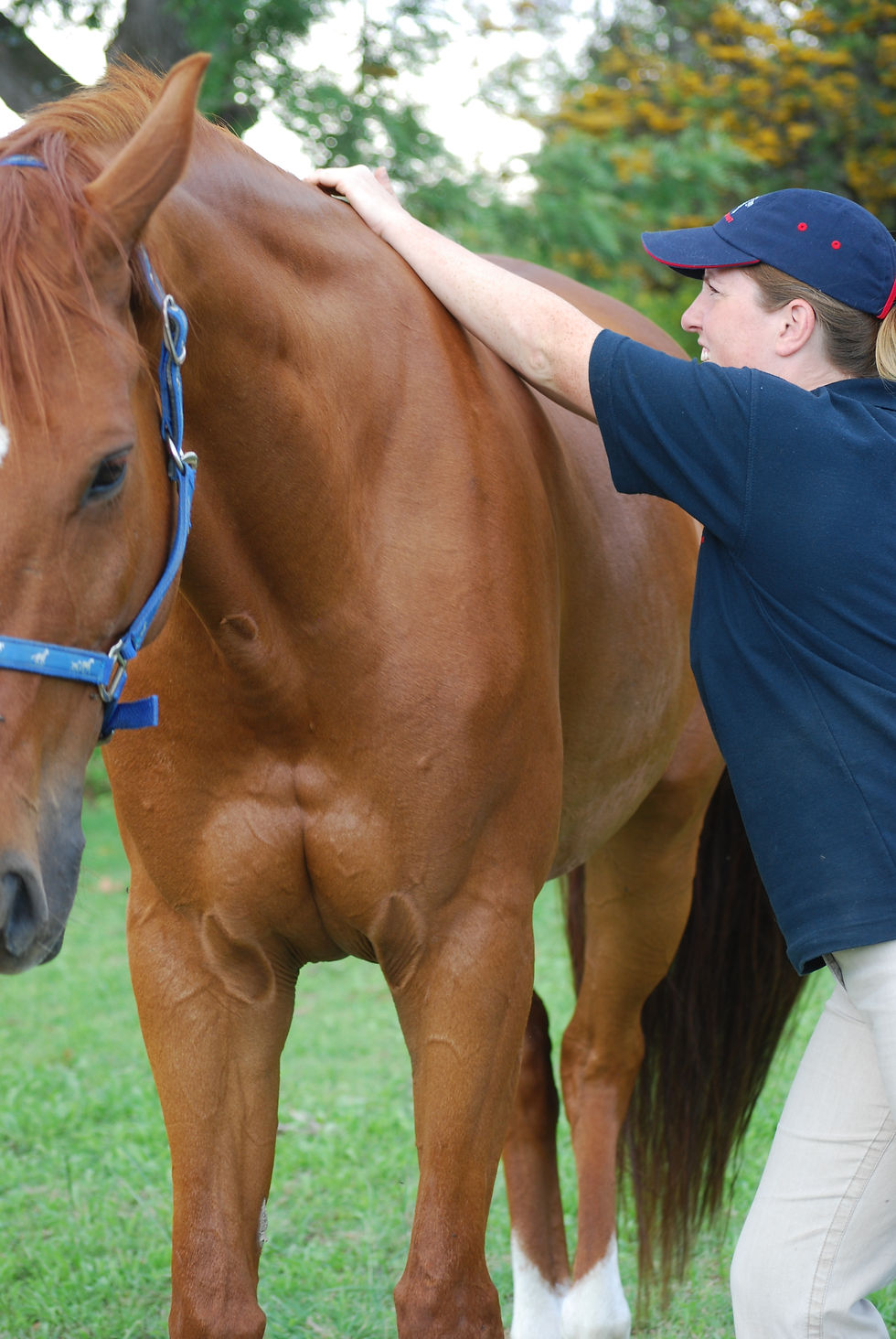
How to Perform the Wither Rock
1. Ask the horse to stand square.
2. Stand facing the left shoulder, with your shoulders parallel to the horse’s spine.
3. Do a personal postural check, ensure you have no tension in your shoulders or arms and take a couple of deep breaths.
4. Place both hands cupping the top of the withers and take a moment to allow the horse to get used to your touch.
5. Imagine the movement first and build up slowly from there.
6. Gently push the withers away from you by about 1cm initially then allow the withers to return to the neutral position before pulling them back towards you by about 1 cm then release again.
7. Repeat this swaying movement in a natural rhythm. The side-to-side movement of the withers should be continuous and flowing. Don’t try to hold his weight in one position.
8. Gradually increase the amount of sideways movement but only as the horse relaxes into the movement.
9. Think of it like pushing a child on a swing, gradually increasing the amplitude and therefore lateral weight shift.
Want to see a video of the Wither Rock? Sign up to the Horses Inside Out Academy – it’s FREE to join and you can access the FREE Tutorial videos. In this library your will find the Wither Rock Exercise, where Gillian explains how to do this exercise correctly for maximum benefit for your horse.
You can learn more about equine Pilates in The Complete Pilates for Horses Programme. This gives you everything you need to confidently start using these hugely powerful and effective exercises that will make a real difference to your horse’s comfort, performance and well-being.
7. Massage the head
If you have ever had an Indian head massage you'll know how powerful and relaxing it can be. Horses too can hold tension in their head, TMJ, face and scalp, and can experience tension headaches as a result of neck tension. Most horses will enjoy and benefit from massage around the head.
A gentle head massage can be wonderfully relaxing after riding and is also excellent bonding time. Start by standing beside to the side of his head and do some simple effleurage (stroking) over the forehead and temporal muscle. The temporal muscle connects into what we call the extensor chain of muscles that go along the top line of the neck and back, there's actually a direct connection from this muscle all the way through to the hind hoof.
It’s interesting to feel and compare left and right – some horses can have a slightly bigger temporal muscle on one side, which suggests that maybe they chew more on one side of the mouth.

Add in some simple ear movements too - effleurage around the back of the ear over the muscles in that area. Some horses really love work around their ears and there are myofascial connections from here to the poll, hyoid apparatus and upper neck joints.
The big masseter muscle – you will find it easier to stand underneath his neck to massage both sides together. Use an effleurage technique – stroking down and back up, in a circular motion.
Continue with your effleurage strokes underneath your horse’s head between the two jaw bones. Now, you’re working on the muscles on the underside of the tongue and the hyoid apparatus. These muscles between the two mandibles continue through the flexor chain of muscles on the underside of the neck and then all the way down to the hind hoof.
Always pay attention to his reaction:
Soft eyes, a lowered head, licking and chewing, or a loosening of the lips are positive signs
Pinned ears, tension, head tossing or pulling away mean it's too much, too soon, or in the wrong place
Take your time and let him tell you what he enjoys. If you find areas of marked sensitivity, heat or swelling, ask your vet or therapist to check them rather than simply massaging them.
If you want to learn more about the structures involved, the anatomy of the head is a fascinating subject and is covered in detail in the multimedia book Illustrated Head Anatomy.
What is Effleurage?
Effleurage is basically a stroking type technique – it's sometimes called stroking. Depending on the speed of your strokes it can be very relaxing for the horse mentally and relax muscles too. This massage technique can help to stimulate the circulatory system, stimulate nerve ending and ease discomfort.
Think of effleurage a little bit like ironing, you’re easing out any tensions within the muscles.
Place your hand on the area of the body that you want to massage. Let your hand mould to the shape of the horse. As you perform each stroke keep an eye on how the horse is responding - this gives you feedback whether he likes or dislikes the speed and pressure that you're using.
Rhythm is really important with massage – as well as helping your horse relax it also helps you make each stroke a continuous motion. Having a constant contact with the horse is also important. As you stroke with one hand, place your other hand over his neck so you maintain contact.
Massage is a great skill to learn - your horse will thank you for it. Our Online Massage Course for Horse Owners is a step by step guide that will give you the confidence and skills to massage your horse with soft tissue techniques that will make a difference to their comfort, health and performance. In this course you are guided through all the different massage techniques, how to put massage routines together and discover more about the anatomy of the horse.
8. Don't forget the tail
The tail is a continuation of the spine, and it's full of muscles, nerves and connective tissue that link directly to the hindquarters and back.
Correctly performed tail exercises can influence balance, core muscle recruitment and tissues associated with the spine. Many horses enjoy them once they are used to them, and they can give you useful information about how he feels. Does he clamp his tail, or hold it to one side? Is it stiff or does it move freely?
However, the tail needs careful handling and it's important to learn the correct technique before you try.
Whole Spine Extension Stretch
This exercise is great for back and fascia release. This is a passive stretch that affects the entire spine. Horses often lean into this and get a lot of relief from it. It’s great to perform this exercise after work as a whole body stretch, to alleviate tension and help reduce the risk of injury.
The aim is to stretch the top line and related muscles, fascia and connective tissue of the entire spine. Only perform this exercise if you are confident that your horse won’t kick. As you do it, listen to your horse, watch for his reactions so you can adjust accordingly. This stretch can be done daily or less often.
If your horse tends to work in a short, tight frame or has tension in the back or hindquarters, this is a good stretch to use.

How to do it
Ensure your horse is standing well and roughly square.
After making sure the horse knows you are there, gently take hold of his tail at the end of the dock. You may wish to wrap the tail around your hand.
Lift the tail so it is at approximately 55 degree angle and so the top line is continuous with the hindquarters. Add a little traction in this position. Stand with your elbows flexed and your chest as close to your hands as possible. Make sure you are standing with your feet directly underneath your hands. Give the horse some time to relax into this position. While you wait focus on your posture, energy and breathing.
Do not pull the horse’s tail. Instead, keeping your body straight, lean back on the horse’s tail, extending your elbows and gradually loading your weight onto the horse’s tail. Imagine doing an upright plank and make sure you keep your ear - shoulder - hip - heel line straight.
If necessary allow for the horse to rearrange his legs and adjust his balance.
Relax and focus on your own breathing to encourage the horse to relax into the position.
For maximum benefit, hold the position for a minimum of 30 seconds or for as long as you feel the horse wants it.
The Horses Inside Out Academy has free video tutorial on tail exercises that show how to do them safely. It’s FREE to join and you can access and watch all the FREE Tutorial videos.
9. Have a cup of tea with your horse
I appreciate that this one does take a bit of time, but it’s well worth it!
Grab a cuppa and sit nearby or in your horse's stable, field or yard, and do nothing. We spend so much of our time asking horses to do things that simply being together without any agenda is surprisingly valuable.
You will probably notice things you would normally miss: how he stands, how he breathes, how he interacts with his neighbours, which leg he rests, how he shifts his weight. You may also find that he comes to investigate you or chooses to stand close by. That's the beginning of a relationship based on trust and choice, rather than demand.
Make sure you are comfortable and safe. Sit where you can move away easily and be mindful of if your horse might be unsettled or become overly pushy.
10. Put poles where you'll use them
I couldn’t not include something about pole work in this article. Many of us have good intentions about pole work, but the poles are in a corner of the arena and the session never happens. The simplest way to do more is to make it part of your daily routine.
Place a line of walk poles on your route to the arena or field, if they are already laid out there’s not excuse not to use them. Walk your horse over them on the way out and back again. Thirty seconds of good-quality pole work, performed regularly, soon adds up. It encourages him to lift his limbs, flex his joints, use his abdominal and back muscles and think about where he is placing his feet.
To get the most from them:
Start with a straight line of poles on flat, non-slip ground
Use a slow, active walk, allowing him to lower his head and neck so that he can look at the poles
Keep the distances appropriate for the size and stride of your horse
Watch his posture: is he rushing, tipping onto the forehand, or tight through the back?
Discover more about how beneficial working your horse over walk poles can be in our on-demand recorded webinar Walking into Strength. This webinar focuses on how walk poles can be used to improve:
Core strength and postural stability
Balance and body awareness
Coordination and clear limb sequencing
Thoracic sling function and abdominal engagement
I explain how pole placement at walk influences spinal control, limb loading and communication between the brain and body.
You’ll learn how to use straight lines, curves and gentle lateral exercises to improve bend, symmetry and movement quality.
Little and Often
None of these ideas should become another list of jobs you must do.
Choose two or three that suit your horse and routine. Try them for a few weeks, watch what happens, and then add something else if you want to. Understanding the anatomy underneath your hands and the biomechanics behind each exercise makes those few minutes far more purposeful.
The more you learn, the more your everyday care will start to feel less like a list of chores and more like an opportunity to help your horse feel and move better.


Comments