

Soundness and Symmetry in the Equine Hoof


Soundness and symmetry in the equine hoof are influenced by a whole host of factors - quite possibly enough to fill an entire book. With that in mind, in this article, Mark Johnson focuses on some of the most common elements he comes across in his daily work as a hoof-care provider.
Early Development and the Importance of Environment
The structure of the hoof - particularly its internal development, or lack thereof - has a profound effect on a horse’s soundness throughout life. From the moment a foal becomes weight-bearing, its interaction with its immediate environment begins shaping its hoof development. The feet, being neuro-sensory organs, send signals to the brain, which in turn responds and directs how those feet grow and adapt.
The first few hours and days of life are especially crucial. The type of stimulation the foal and its feet receive during this time lays the foundation for healthy development. Movement, the type of ground they walk on, and their diet all play vital roles in influencing this process.
Looking Inside the Hoof
As a horse matures, the old saying “no foot, no horse” starts to take on a deeper meaning. When I talk about this, I’m particularly referring to the internal structures such as the digital cushion and the ungular (or collateral) cartilages — the inner, caudal part of the hoof. These components provide cushioning, strength, and support not only for the foot but for the entire limb and body. They create the necessary space and mechanical movement for healthy circulation of blood and lymph throughout the hoof.

The hoof’s connection to the rest of the musculoskeletal system has a major influence on how it develops and responds. Static load, flight, conformation, gravity, body weight, and any compensations for existing pathologies all leave their mark, showing up as visible responses within the feet.
How Movement Shapes the Hoof

Although the knee and hock joints aren’t simple hinge joints, being made up of multiple bones, once growth plates mature, they act much like hinges. As these joints flex during forward movement, their motion over the top of the hoof determines where the break-over occurs. By studying the wear pattern on the hoof, whether shod or unshod, we can usually trace the line of travel quite accurately.
The Question of Symmetry
Symmetry is something we humans are naturally drawn to — we like things to look even and balanced. We want our horses to have symmetrical muscle development and equal ability on both reins. While this is a worthy goal, it can sometimes clash with the horse’s fixed skeletal conformation. In other words, there’s always a risk of asking for something the horse physically can’t deliver.
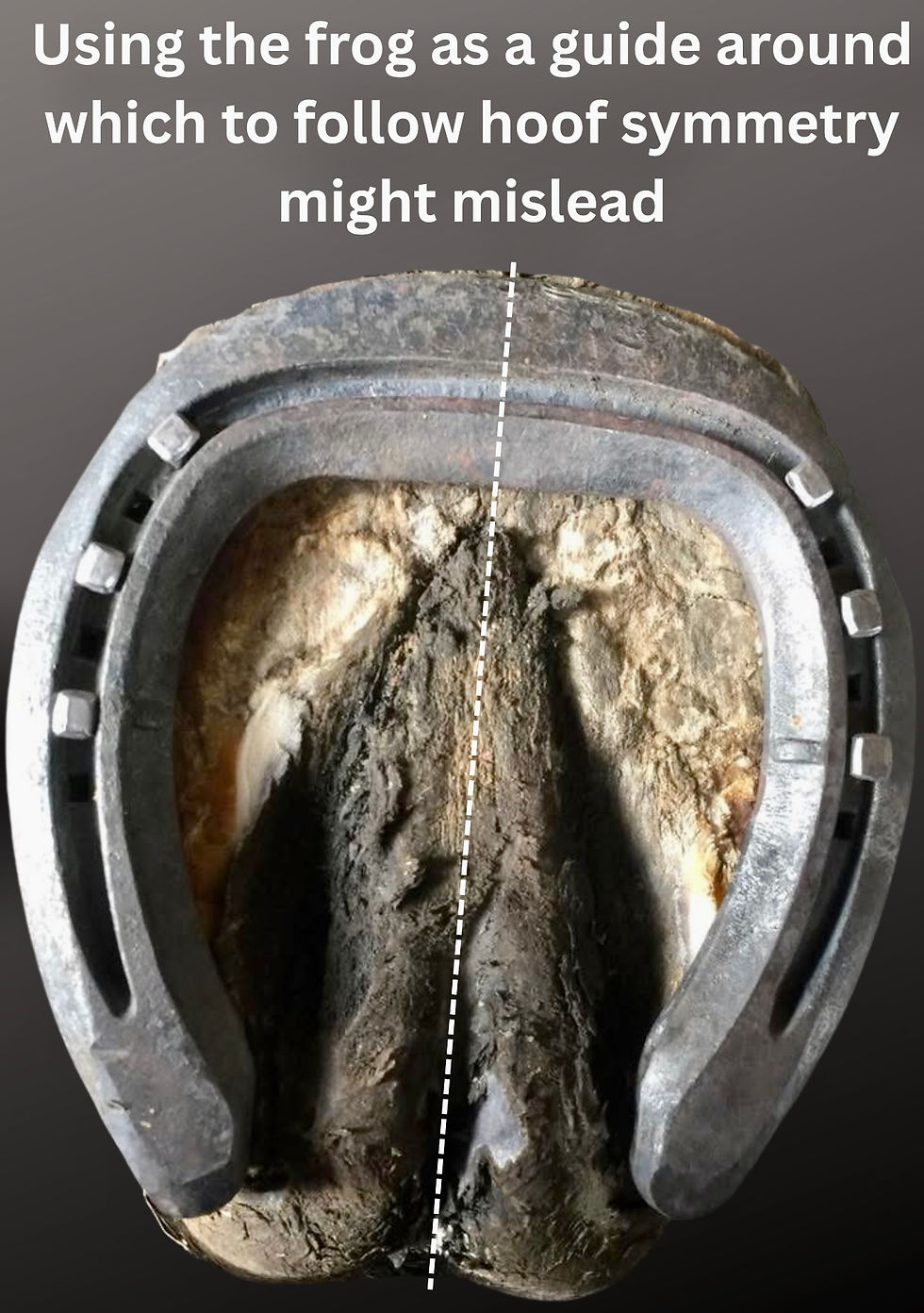
Here’s an example. In an old photo of a foot I once shod using natural balance principles, the shoe was fitted symmetrically to the foot — within reason.
Thanks to its forgiving nature and bevelled outer edge, the shoe allowed for an easier break-over, enabling the horse to move off on a slightly non-central trajectory.
That’s very important for maintaining harmony between hoof, limb, and body - rather than having the hoof “fight” against the leg and ignore the natural line of flight.
Freddie Fox’s Limb Alignment

Let’s look at this idea from another angle -quite literally - by examining the skeletal limb stack of none other than Freddie Fox himself, focusing on his right forelimb.
If you study his leg, you’ll notice that the knee joint and cannon bone are nicely aligned. However, the fetlock joint and lower pastern/pedal bone are not perfectly in line. This fixed skeletal arrangement means Freddie, like many horses, was conformationally predisposed to land slightly on his outside toe first.
Now, that doesn’t mean he was an obvious “outside toe lander” — the full extension of his limb would alter the angle somewhat — but it does reveal where the bias lies. This pattern of loading is visible in the composite shoes he wore and in his preserved hooves, which show compression through the sole on the outer aspect.
Want to see what else we learnt about Freddie's feet and skeleton? Check out chapter 4: Hoof Care and Balance of the Bare Bones of the Matter Documentary Series.
High/Low Syndrome and Its Effects

Another common influence on soundness and symmetry is what we call high/low syndrome — where one hoof appears flatter or lower and the other more upright or “boxy.”
This condition can result in two scenarios:
A horse that looks lame but technically isn’t, simply moving according to its conformation
A horse that is lame, due to misaligned joints, uneven limb lengths, a rotated shoulder, or a combination of these factors
High/low imbalance often reveals itself throughout the entire body. You’ll frequently notice one knee higher than the other, misaligned or unevenly developed pectoral muscles, and from behind, one shoulder or scapular apex appearing more prominent while the other side drops away.
Depending on the severity and underlying cause, these horses can often be helped. Skilled bodywork and sympathetic saddle fitting are essential. From a hoof-care perspective, it’s important to understand that the boxy, more upright foot is actually on the low side of the horse. In many cases, this foot may need further elevation, particularly if the flatter foot requires a caudal raise to assist with digital alignment.

Always More to Learn and Discover
This article only scratches the surface, but I hope it opens the door to more conversations and questions, and there’s no better place for that than joining us at the Horses Inside Out Conference 2026: Soundness and Symmetry.
Two days of amazing presentations from leading equine experts. Plus, there's the incredible equine anatomy exhibition that includes, the great Freddie Fox himself and lots of other fascinating exhibits that focus on Soundness and Symmetry. And that's not all....there are trade stands, scientific poster competition, celebrity chat zone and much more.

I can’t wait, you will find me in the anatomy exhibition. There’s nothing I enjoy more than chatting about horses and their feet, so, if you're going and if you're not - why not? You really don't want to miss it. Please drop by and say hello!
Mark Johnson


Comments